Temperament first
Temperament is our highest priority. A structurally beautiful cat that does not have the temperament we want is not automatically a long-term breeding cat.
Dusty Pawz began with a Himalayan named Bear and the kind of bond that changes what you believe a companion animal can be.
Our first Himalayan, Bear, came from a breeder in Israel. He was deeply loved and, after we lost him, we wanted to preserve the kind of temperament and companionship that made him unforgettable. Boba later came from the same breeder and became the foundation sire of Dusty Pawz.
That experience shaped the goal of the program: produce Himalayans that are beautiful and recognizable as the breed should be, but above all, produce cats whose families come back years later to tell us they found their own “soul cat.”
The Himalayan is becoming less common as long-time breeders retire. We want to contribute responsibly to its future while remaining deliberately small—never more than a handful of breeding cats and no more than four queens.
The point of selective breeding is not perfection. It is honest evaluation, predictable improvement and choosing pairings that complement one another.
Temperament is our highest priority. A structurally beautiful cat that does not have the temperament we want is not automatically a long-term breeding cat.
We look at the whole cat. If one cat has a feature we want to improve, we seek a mate that is stronger in that area rather than pairing two cats with the same weakness.
Pedigrees, genetic diversity and coefficient-of-inbreeding data are part of planning. We also consider what families and catteries consistently produce over generations.
Colour is enjoyable, but it is not a substitute for health, temperament or structure. We choose the cat first and the colour last.
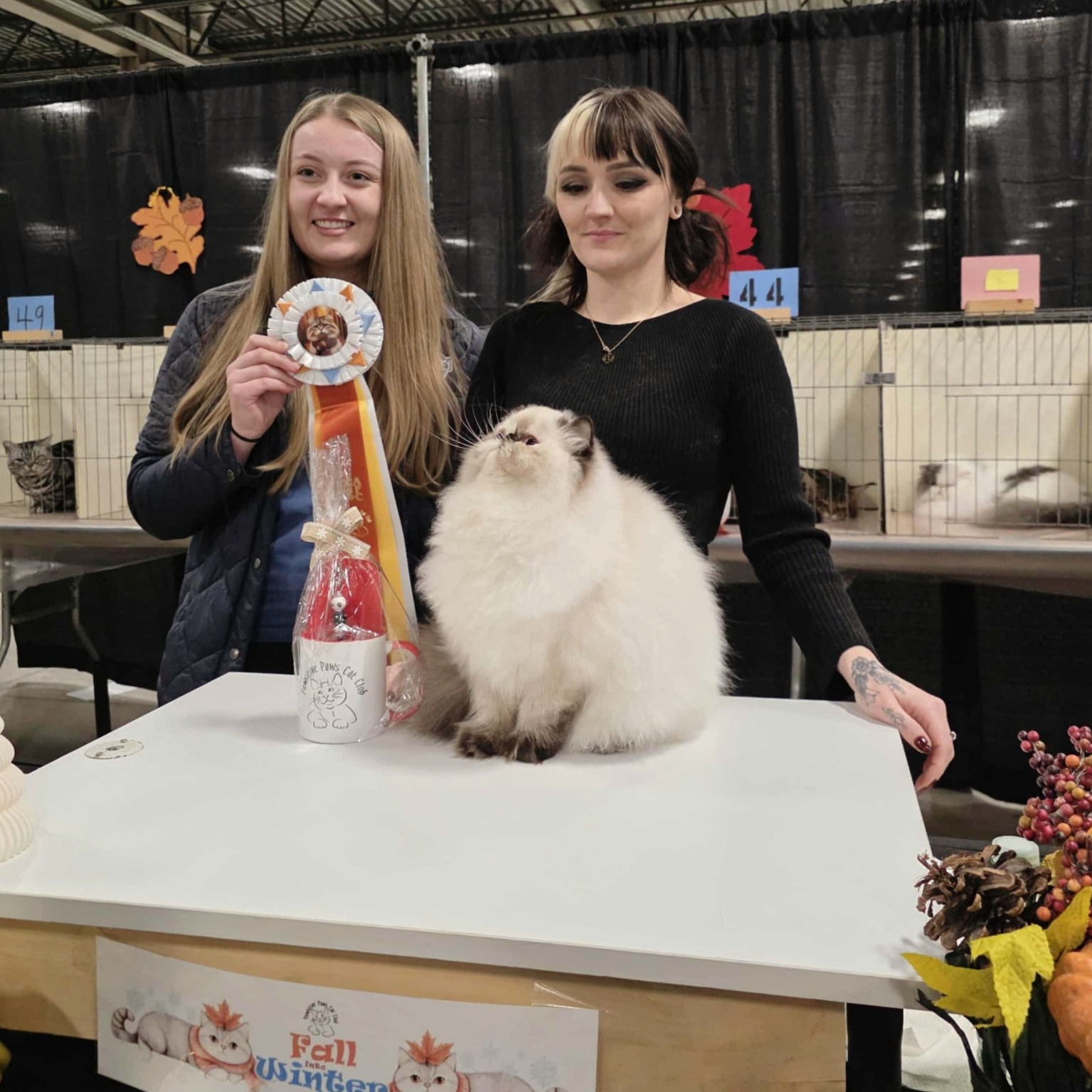
We actively show with CCA-AFC and TICA. Showing gives us outside evaluation of structure and breed type, helps us stay accountable to the standard, and lets us learn from judges and other breeders.
Shows are also an opportunity to meet the public and explain responsible breeding. We only show cats that are comfortable doing it; a title is never worth repeatedly stressing a cat that hates the experience.
Showing is one tool, not proof of ethics by itself. A breeder can show and still make poor choices, and a breeder who does not show can still produce lovely cats. The questions behind the program matter.
Breeding decisions are made around the cat in front of us, not a production calendar.
Our girls are bred approximately once a year when they have fully recovered, returned to normal condition and have veterinary approval. If a queen needs more time, she gets more time.
We pay attention to how a queen feels about motherhood. A cat that dislikes raising kittens does not need to keep doing it simply because she can.
Retired adults are altered and placed in carefully selected pet homes when that is the best life for the individual cat.
Outside the breeding program, I work professionally as a cat groomer. That experience translates directly into coat care, handling, show preparation and the grooming education our kitten families receive.
The annual gala is where CCA-AFC exhibitors come together for dinner and recognition of the season's national and special award winners. Rather than turning the entire website into a trophy cabinet, each cat's major accomplishments are listed on their own profile.